Sunday, February 28, 2021

Teamwork Across Organizational Boundaries

 It seems like an inescapable law of nature, that the larger an organization becomes, the more inefficient it becomes. This is especially true with large corporations and governmental entities, where massive oversights and organizational flaws can go unnoticed for years, while in a mom-and-pop shop every employee's job makes sense and every penny allocated is accounted for. There are many reasons for this phenomenon, and many of them stem from the core principle of the individual worker's job duties becoming increasingly specialized and narrow as the operation grows in scale. 

Back to mom and pop, the two of them could be the floor manager, accountant, HR, CEO, and many other things all at once. But once there are multiple locations with specialized products, suddenly each duty becomes so big that it necessitates a dedicated specialist. Accounting grows rapidly in complexity as an operation becomes more sophisticated, with more parties involved. Within these larger organizations, a common expression is 'the left hand doesn't know what the right hand is doing', and this really captures perfectly how necessary links in a process can unwittingly (or uncaringly) work against each other.
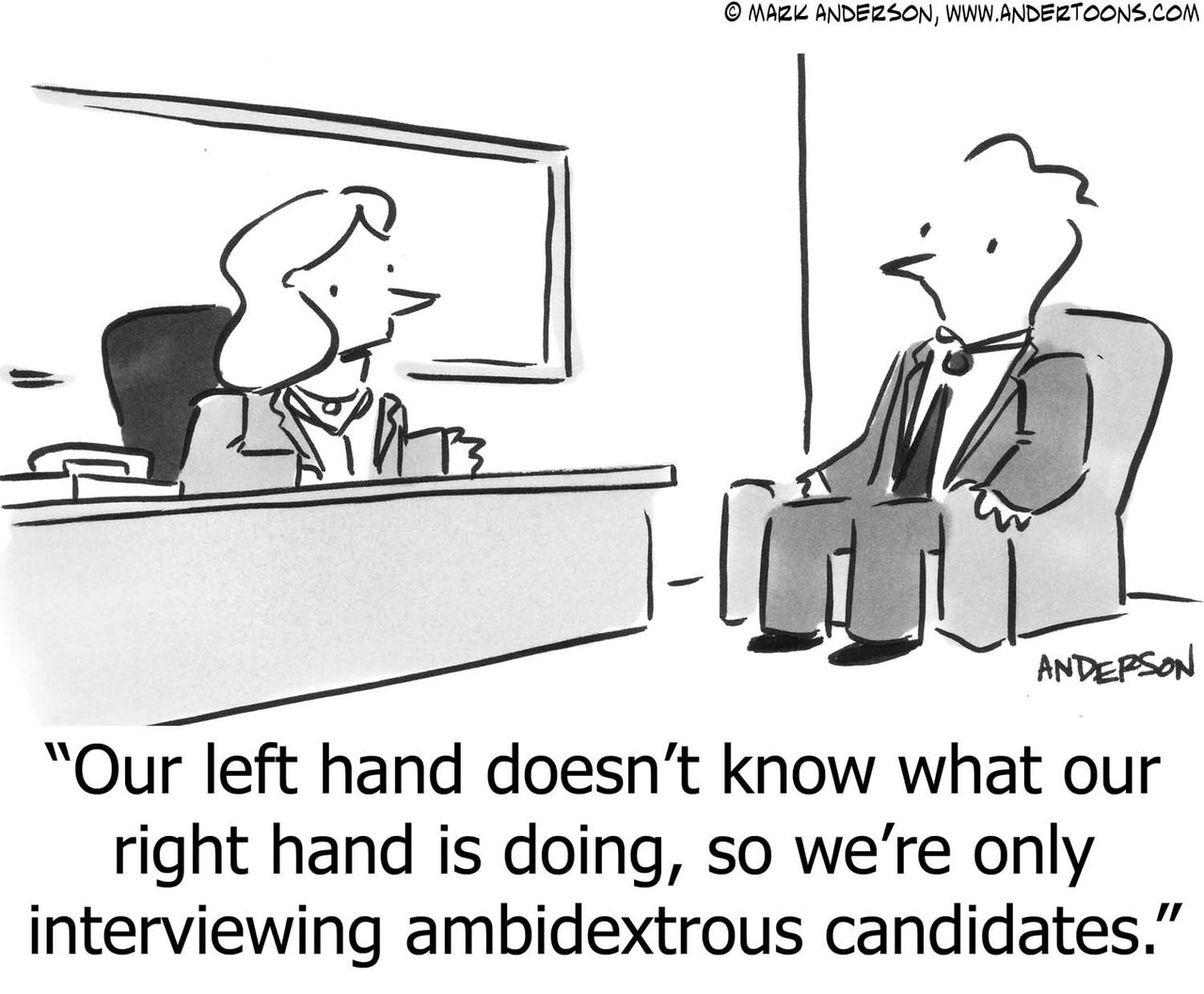
In an article I reviewed this week, Get Your Team to Work Across Organizational Boundaries by Brad Power, this issue is explored and strategies for addressing it are discussed. It is stated that teamwork across organizational boundaries is unnatural, that the natural tendency of organizations is to optimize locally — within a business unit or department, rather than optimizing for the global customer experience or the enterprise.  A key driver of this problem is identified as disparity between local metrics for success conflicting with the organization's success as a whole. For example, a warehouse manager is not likely to identify an opportunity for company savings by contracting a third party warehouse and selling the company's. 

Also, there is the potential of one team to undercut another in order to magnify their own successes, even if it drives failure for others. Such behaviors are often seen in call centers, where call duration is a primary metric, and therefore rewards customer service making unnecessary transfers to other departments in order to shorten their own calls at the cost of the customer's experience.

For an organization as a whole to begin addressing this disunity, unfortunately it often takes a crisis. Only when the company's feet are held to the fire, and senior leadership really drives the company's overall goals consistently, do these disparate parts of the team finally begin working in consort. However, it doesn't have to require this, as noted by Power. It can start by having leadership begin addressing the core issues head-on before a crisis is caused.

The article suggest having a workshop for a few days, taking key members of a variety of teams, and bringing them together for a common goal. At first, the group begins to identify the flow of the company's core service in a realistic and fundamental way. Perhaps from the customer's point of view, or from a spending perspective, some way that takes them out of their own personal role and gives their actions the context of their greater significance in the big picture. With input from all members, they can begin to see a cohesive picture and understand more clearly how their actions can help or hinder the overall effort.

Next, the workshop needs to focus on addressing problems in the system, as mentioned either by leadership or brought forth by the team members themselves. Often the best solutions come from the workers and not the managers, as they have insights that simply can't be obtained elsewhere. Interdependent parts of a process begin collaborating towards a common solution, and thus the law of nature begins to recede. 

However, the workshop is only one step of a whole organizational change in strategy that must be followed through with. Ideas will only survive and manifest results when they can be stuck with by all that matter, and the workshop attendees must convince their team members of the logic of the plan they helped collaborate on. Management must support these new initiatives and develop drivers that reflect progress in the new direction that can be monitored.

Many reform efforts fizzle out after an initial push, and thus reinforcements and follow-up meetings should be had. A certain measure of flexibility is smart, as flaws in the plan that can be amended shouldn't be cause for the whole effort to fail. One way to reinforce a cohesive vision is through social media, an internal workplace platform.

These social media platforms have been employed by many companies in recent years, creating their own version of LinkedIn or Facebook for internal use. This provides opportunities for networking and collaboration, and a more informal way to voice concerns and opinions. The vision of unity and cohesion for the company can be better appreciated when these far removed team members can put a face to a name, and better understand their own place within the larger scope.

In my personal experience I have seen successes and failures at accomplishing this unity. A successful example would have to be efforts by the Air Force to create a sense of worldliness in its members. 'Cross pollination' trips are commonly taken where members of one base travel to another to shadow their counterparts, where both sides can understand and learn from each other. This allows for local inefficiencies to potentially be highlighted by the superior performance of the other party, a sense of networking and collaboration as members of the larger Air Force, and it can foster understanding of the process drivers that both sides are subject to.

An example of misguided efforts to unify members of multiple different teams would have to be the new hire training class I attended at one job I had. It provided a very extensive look at some of the company's processes from a higher perspective, giving an understanding of how some roles fit with each other. Unfortunately, this was almost a complete waste as the material was very out of date, and some of it seemed to be directed at a particular team, leaving many other teams unaware of the significance of their own role. The training ultimately left us more confused than when we came in. Needless to say, the trainer's awareness of the roles of their trainees can be useful information to have.

As for the social media aspect, Boeing has its own social media platform called inSite. This functions most similarly to LinkedIn from my personal experience, and seems to serve primarily as a way of looking up coworkers to learn more about them and the organization they belong to. This can serve as a resume of sorts, detailing career history and listing qualifications. In addition to the employee profiles, there are also groups where articles are shared and web meetings can be arranged. There are some groups based around particular career fields or programs aimed at fostering collaboration. In my experience, this platform is highly under-utilized and very few people I know make much use of it, so there is likely a lot of untapped potential.

Sunday, February 14, 2021

The DIKA Model

 Information overload, also known as infobesity, is a major problem in both the business world and our society at large. Thanks to advancements in technology and the increased prominence of the global marketplace, access to data of all kinds has become much easier than ever before. Within an organization, we can now track many kinds of metrics and performance data in real time, giving rise to concepts like the Six Sigma and Just in Time models. Such plans that demand near-perfection and transparency would have been much more difficult to implement in prior generations.

There is reason to suspect that our obsession with performance data is killing performance, especially when it comes to employee expectations. However, data when properly used can be converted into powerful competitive advantages over the rest of the industry. Effective data collection, collation, and interpretation is something many businesses struggle with, but industry leaders tend to rely on. One tool to assist with informing decisions using available data is the DIKA model.

This is a simple workflow of sorts that can be used to guide the process of exploring a decision or issue and allowing the data to organically form a recommendation. It might be employed in order to solve a problem, or to decide on a course of action informed by historical data. The idea is an exhaustive collection of potentially useful data points are then analyzed, and only at that point is a theory crafted. In a complete subversion of the scientific method, data is collected and analyzed in order to form a hypothesis, not after.


During the information step, data is analyzed and measured against each other. Such patterns as reinforcing data points and consensus among disparate sources of data can be used to group the data points. The information step is more about pruning, reducing that exhaustive data list down to what appears to be the most founded facts. If there is something to prove, the facts with the most evidence in the data receives the priority. These most reliable pieces of data are renamed information.

The knowledge step should have expert or experienced analysts work on the refined list of information. A theory or hypothesis is extrapolated from the accumulated information. Although understood with the lens of expertise and context, it must ultimately be the information itself that points towards and justifies the conclusion. This interpretation of the information is called the knowledge.

After this, a plan of action is made and set into motion. The final step is no longer about making decisions but rather should consist of actionable recommendations. This may seem straight forward, but it may end up being one of the most time consuming steps, because converting a goal into immediate steps can be complicated. 

Like any data-driven decision making methodology, an analyst's understanding of the context of the data can help to ensure this is a powerful tool. Likewise, a lack of context can allow this to go off the rails. Businesses are inundated with data and it can be incredibly difficult to convert the recommendations in the data towards action items, especially within large organizations.

Unfortunately, within large corporations in the modern business world, short-term goals often take precedence over long-term goals. This is partially due to the quarterly and annually appraisals due to senior leadership, especially to the stockholders. Because of this, there is pressure to produce tangible results now, even if there may be long-term ramifications. The one metric everyone is measured on, in one way or another, is the profit margin.

This is to say that far too often, a sound and data-supported proposal will be shot down because there is a short-term expense. The more intangible or far off the benefits are, the greater the chance of the proposal failing is. Not every endeavor can be supported by data that will give reassurances of increased profitability of a certain amount. There is an art to persuading leadership to take risks, but any amount of framing will only have so much potential to move.

There is a vast number of situations this model could be applied to, some of which may benefit more than others. I believe that the defining feature of successful applications is its ability to increase profitability. If the DIKA model shows a certain path will lead to profits, management will be firm believers, but if it shows a path that leads to increased expenses then suddenly management will have their doubts. 

Sunday, February 7, 2021

The Future of Lying

 The act of lying is perhaps the most difficult to rate in terms of seriousness. In conversation, it is often used as an example of an insignificant offense, such as saying, "We can't throw people in jail for every immoral deed. If we did for lying no one would be left!" However, it can also be considered the most grave offense in a different context.

Warren Buffett once said, "In looking for people to hire, look for three qualities: integrity, intelligence, and energy. And if they don't have the first, the other two will kill you." In any professional or personal relationship, without a foundation in honesty and trust there can be no merit to any other redeeming qualities. Furthermore, knowing basic facts such as intentions, capabilities, and history can become impossible.

However, what of the little white lies that so often are told, never detected, and often even forgotten by the liar? The line can even become blurred on what truly constitutes a lie when a misrepresentation is used. One might, bring up a real traffic jam encountered to explain tardiness, without mentioning that they left their house late in addition. Does a system of morality compel them to unnecessarily divulge their guiltiness, perhaps even to exclude the real but unimpactful traffic jam? 

Such questions about the common lies told daily by most people are divulged in a TED talk by Jeff Hancock in 2012.

In this talk several studies are discussed that explore the ways people lie online versus in-person. Perhaps surprisingly, the study found the test subjects lying much more frequently in-person than online in most metrics. For example, e-mails were shown to contain much fewer lies than phone calls. One reason for this may be the pressure, being put on the spot, that might drive someone to panic and lie when a well thought out e-mail might allow them to find a truthful response that would protect their relationship. And this takes us to the motivation for lying.

Aside from a small amount of pathological liars mentioned, most lies are done actually to protect relationships. Claiming to be busy and can't talk, when really they are simply not interested but want to spare the other's feelings, is one of the most common modern lies told. There are other motivations, but when it comes to little white lies most of the motivations seem to relate to preserving a relationship. My personal take in contrast to the presentation, is that ego plays a large part. Sparing a friends feelings may be a motivator for most, but many times its a sense of pride and a fear of embarrassment that's even more powerful when it comes to discussing a failure.

So, what has changed about all of this within the last 20 or so years? Despite the anonymity of the internet allowing certain kinds of lies (like fraud) to flourish, when it comes to interpersonal relationships online communication has the opposite effects. There is now a permanent record of everything we say online, inescapable. Using other forms of communication lies could be used to escape being caught in a prior lie, like creating doubt that the listener heard correctly, or attacking another's credibility. But now, text messages and social media posts speak for themselves. In a way, many people continuing personal relationships online have fewer lies they can possibly tell.

We are now made more available than ever before. Back in the 1970s, you had a home phone but no answering machine. Consequently, there was far less expected contact, so we had much less reason to lie in certain respects. There is no need to say the cell phone battery died to explain not responding for a full day. Our expectations drive people into a corner where they either have to be brutally honest, or come up with white lies to preserve the status quo. However, lying is more difficult now due to the lasting record.

In conclusion, there is no real conclusion here as this topic is incredibly broad and nuanced. Our technologies enable certain kinds of lies, while making other kinds more difficult, but don't change our core motivations much. We're still humans with the tendency to lie. In the 8 years since the TED talk linked, I believe the propensity for lying online has gotten much worse. When honesty becomes scarce in a society, those who humble themselves and display it shall be exalted.

Applying Communication Strategies

      It can often be difficult to extrapolate actionable recommendations from high-level concepts. A teacher could advise that managerial c...